Showing posts with label Historical Places. Show all posts

Monday, April 18, 2011

San Agustin Museum

San Agustin Museum In Intramuros, Manila

The San Agustin Museum used to be the Monastery of the Order of Saint Augustine inside Intramuros. In 1973, the monastery was converted into a museum that houses a vast collection of Filipino, Spanish, Chinese and Mexican art treasures.

The original monastery building was destroyed in 1945 during World War II.

A 3,400 kg bell that used to hang at the belfry of the San Agustin Church greets visitors at the entrance of the museum. Inscribed on the bell were the words "The Most Sweet Name of Jesus."


Right after the bell, the first hall inside the museum is the Sala Recibidor. This former classroom and receiving area now houses the ivory art collection of Luis Ma Araneta. Aside from the ivory statues, there's the XVIII th Century wooden retablo of the Intramuros Administration; the chalice, monstrance and other church artifacts on display were either cast in silver or gold and embellished with diamonds and precious stones like amethyst, emerald and ruby.

The monastery has four massive corridors that serves as an exhibit hall for the oil paintings by Filipino artists like Enriquez and Fuster, as well intricately carved century old Chinese drawers and XVIII th Century carrozas used for processions inside and outside the church.


first floor corridor

carrozas

Right after the Sala Recibidor is the entrance to the San Agustin Church. Please read a separate entry on San Agustin Church here .

Next to the Church is the Sala De La Capitulacion or the old Vestry where the priests dress up in preparation for church activities. It is here were Governor General Fermin Jaudenes drafted the terms of surrender of Manila to the Americans in 1898. It now exhibits church artifacts and paraphernalia.

The Sacrity of the former monastery follows the Sala De La Capitulacion, in display in here were Aztec inspired doors and frescoed walls, China chestdrawers, statues and paintings.

Next to the Sacristy is the Refectory/Sala Profundis. The Refectory was the former dining room and next to it was the Sala de Profundis were the priests say their prayers before and after their meals. The refectory was converted in 1932 into a crypt for Augustinians and later on for other Filipino families.

The crypt gives me the creep.:) I was not able to look around because there's this heavy feeling inside this part of the museum. In my haste, I failed to see Niche 87 where Filipino Painter Juan Luna is entombed as well as the monument in memory of the victims of the Japanese occupation of the Philippines.

The main staircase of the monastery that leads to the second floor is made from 44 pieces of Chinese granite stone brought in 1780 from Canton.


The perfectly round dome at the staircase is made from light bricks with six rectangular windows.

The second floor of the cloister is made up of the San Pablo Hall with the model scales of the San Agustin Church and Monastery; the San Agustin Hall that showcases the paintings and photos of churches built by the Augustinians from 1565-1898 as well as the Filipino Grammars and Dictionaries written by Augustinians; the Porcelain Room which houses the shards of porcelain excavated form the San Agustin complex and the Church Vestment Room where XVII and XVIII th Century liturgical vestments worn by the friars are on display.

The Oratorio/Antechoir/Choirloft is accessible through the main staircase of the museum, please read my post on that through this link.

second floor corridor of the museum

Two hours inside the museum is not enough to explore its every nook. I'm looking forward to visiting the San Agustin Museum soon.

San Agustin Church in Intramuros is open daily from 8:00am -12nn and from 1:00 pm -6:00 pm. Tickets for the museum is at P100.00.

Thursday, April 14, 2011

The Treasures of San Agustin Church


Treasures of San Agustin Church in Intramuros, Philippines

When you visit San Agustin Church, you can proudly say that you visited the oldest stone church still standing in the Philippines. The construction of this church was started in 1586 and was completed in 1607. The church is the only one out of the seven churches within the Intramuros that remained standing after World War II. And you can boastfully declare right after your visit that you have seen one of the four baroque churches in the country designated as a World Heritage Site by UNESCO. :)

interior of the church

The outer facade of the church is very simple but don't forget to take a closer look at the ornately designed wooden carved door at the entrance of the church. Carved in the main door are the images of the Order of St. Augustine's founder Saint Augustine and his mother Saint Monica as well as the emblems of the Augustinian Order. The bell tower on the left side of the church was destroyed by an earthquake and the bell that used to hang on it is now displayed at the adjacent San Agustin museum.

But its simplicity on the outside belies the beauty that can be seen inside the church. The inside of the church is in the shape of a cross. It has a vaulted ceiling and a painted dome, done by Italian artists Alberoni and Dibella. On its ceiling hang XIXth century old chandeliers . Within the church are 14 chapels and tombstones on the flooring.


one of the chapels within the church

Don't forget to visit the tomb of Miguel Lopez de Legaspi, the founder of Manila at the side of the altar.


the chapel that houses the remains of Miguel Lopez de Legaspi


tomb of Manila founder, Miguel Lopez de Legaspi

Displayed at the choir loft are 68 pieces of magnificent carved molave choir seats with fine inlays, the majestic XVIIIth Century Pipe Organ and a big lectern with cantorals.


the lectern with the cantoral and the intricately painted dome of the church


intricately carved molave choir seats


the huge pipe organ


If ever you're in Intramuros don't forget to drop by San Agustin Church. :) San Agustin Church is at the corner of Juan Luna and Real Streets in Intramuros, Manila.

Saturday, April 10, 2010

National Museum - The National Art Gallery


The National Museum - The National Art Gallery

This is the continuation of my post about the National Museum. The first part is about the National Museum's Museum of the Filipino People located at the old Finance Building, here's the link to that post .

This second part is about the National Museum's National Art Gallery.


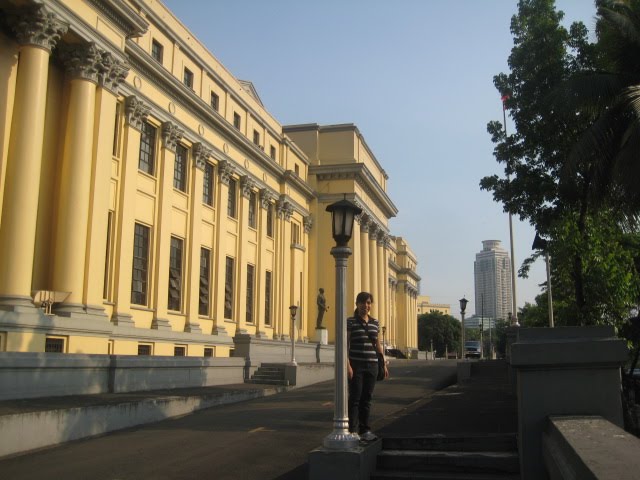
The National Museum - National Art Gallery is located at the Old House of Congress near the Manila City Hall facing the Intramuros golf course. It serves as the repository of art works and masterpieces of Filipino artists.


This building which houses the National Museum's National Art Gallery was originally designed by American architect Ralph Harrington Doane to become a public library in 1916. The construction was halted due to lack of funds. Later on, it was decided that it will become a Legislative building. Filipino Architect Juan Arellano was commissioned to continue the project. It was inaugurated in 1926. The first floor of the building became the National Library while the second, third and fourth floors were occupied by the offices of the Senators and House of Representatives.

It was here where the Constitutional Convention of 1934 was held and outside the building steps where President Manuel L. Quezon took his oath as President of the Commonwealth.

The Senate moved out of this building in 1996 and renovations were done in 2003 to transform it as the National Art Gallery .

The National Art Gallery is home of Juan Luna's Spoliarium.


The oil canvas measures 400 x 700 cm, it depicted dead gladiators being dragged into the shadowy area of a roman arena. The Spoliarium won the gold medal at the Exposicion National de Belles Artes in 1884.

The painting reflected the maltreatment, abuses and the discrimination of the Spaniards against the Filipinos they considered to be indios.


The Spoliarium is found at the second floor of the museum at the Hall of the Masters. The Hall of the Masters exhibits the paintings of National artists - Juan Luna and Felix Ressureccion Hidalgo.


Behind this door is the Spolarium.

It is also here where you can find a sculpture made by our National Hero Jose Rizal while he was in exile in Dapitan. The sculpture is entitled a "Mother's Revenge." A dog came to the aid of her puppy being attacked by a crocodile.

Aside from works of arts by National Artists, there's a room also where you can find bone collection of various animals including that of the huge sperm whale. The National Art Gallery also houses a Herbarium.

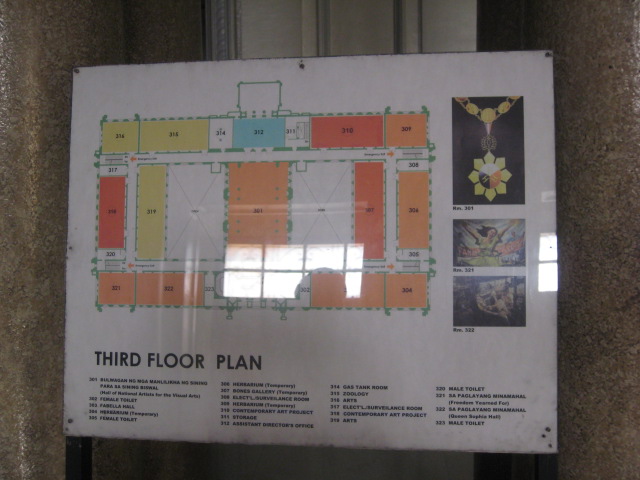
Below is the second and third floor plan of the museum with its corresponding rooms and galleries


A whole afternoon inside the National Museum is not enough to explore the richness of the Filipino Culture. My brother and I will be back to visit it again.

The National Museum - National Art Gallery is open Wednesday to Sunday from 10:00 am to 4:30 pm. 

* When my brother, my bf and I revisited the museum last November 2011, we were allowed to take souvenir shots of the art works inside the museum.  We also learned that we don't have to pay the P75.00 entrance fee every Sunday.  Here are some of my favorite artworks:


The Spoliarium by Juan Luna


La Bulaquena by Juan Luna


The Assasination of Governor General Bustamante
by Felix Ressureccion Hidalgo


the unfinished portrait drawn by
Fernando Amorsolo
at the background are the framed pencil sketches
of the late national artist

LinkWithin

Related Posts Plugin for WordPress, Blogger...